Showing posts with label OPOs. Show all posts

Monday, December 24, 2018

A test of strength and endurance and the Quickest Tomato Soup (inspired by OPOS ) for comfort.

October 2017 was an important month, for us. My son earned his Recommended Black Belt in his Tae Kwon Do training. 

We were that one, very crucial year away from the coveted First Dan Black Belt. We were given a folder with the curriculum and what was required to test. 
It was a lot, I thought. How will my baby do all that?  I watched him during his classes. I saw him do well in his forms and weapons classes. I saw him falter and get nervous during his sparring lessons.

As the weeks went by, his skills got better and I sighed with relief. But, we went to India for the summer and while that was a fantastic trip, it robbed us of 2 months of lessons, It was a lot to cover up. How was my 10 year old going to do this? That was the mom in me. Over protective and anxious. 

As the time for the test came closer, he trained harder than ever. 
And finally, it was time. 
The testing was a 2 day affair. Day 1 where his physical strength and endurance were tested. 
As I sat chewing my nails and worrying, he kept doing all that was demanded. He panted and held his sides after every test, his face and hair slick with sweat. Some of the other aspirants lay down with the exertion, only to stand up in a minute for the next test. Every muscle in his body was sore and screaming for rest. 3 hours and 1 water break later, we trudged  home, exhausted.
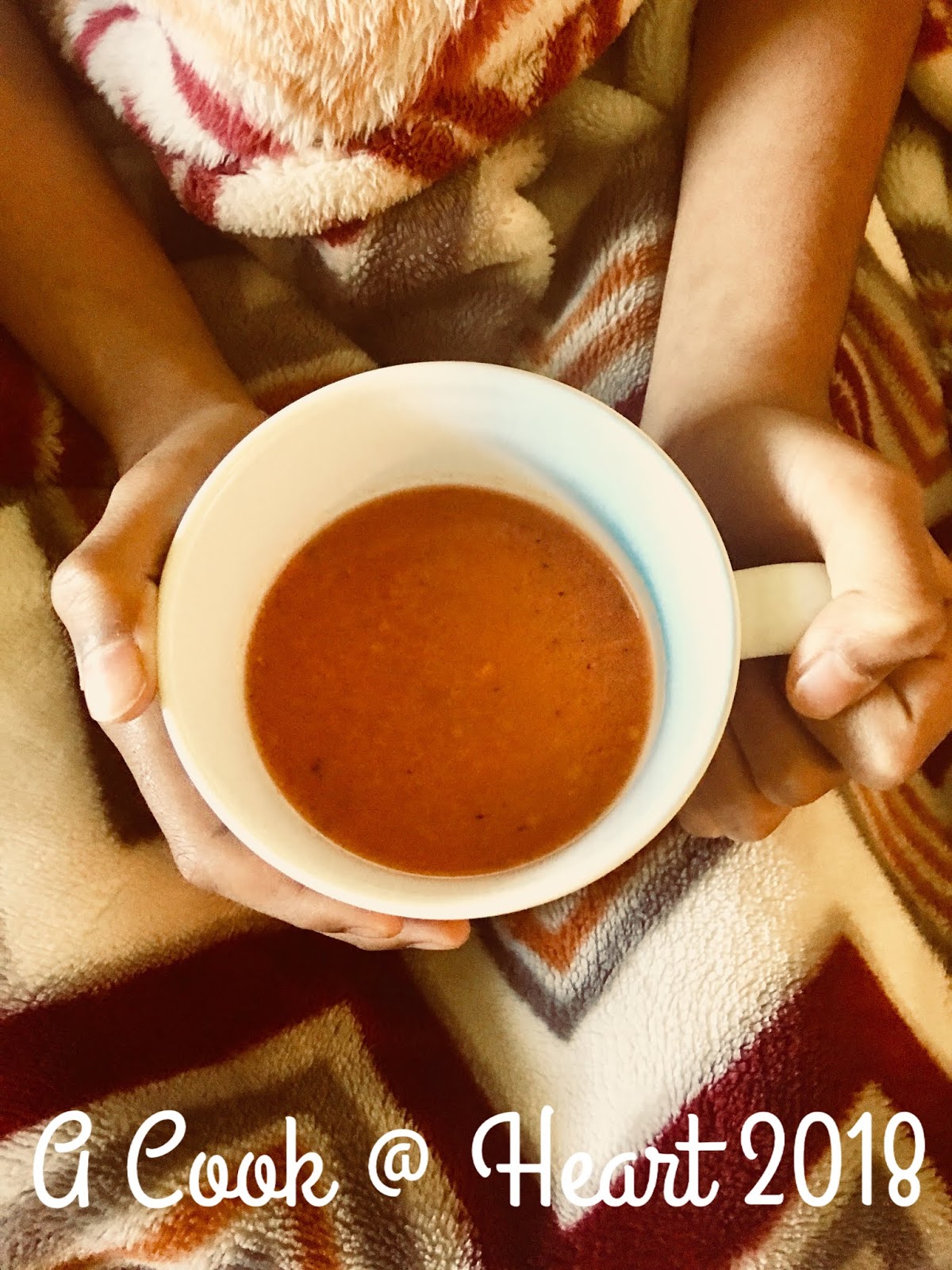
At the end of the day, we were happy, exhausted and above all, in need of comforting food. Since we had gone over the estimated time, All I could do was whip up this amazingly quick Tomato Soup and grill some cheese sandwiches on the side. I OPOSed the soup  (recipe below) and it was ready before my sandwiches! 

To continue... Day 2 was an all day test, which ideally would've begun with a 5k run, but weather did not permit it, so that was postponed. The written test, poomsae, weapons, sparring, self-defense and board breaking were the order of the day. 
As a parent, no matter of how much you support your child and push him / her to excel, when you see your child getting kicked and punched in sparring or surrounded by 4 other black belts who kick, punch, pull, push, pile on to him and he defends himself, you want to just get on the mat and wallop the daylights out of them and save your baby! It was the hardest 30 minutes of my life. I wanted to jump in that fray and save my baby, in hind sight, I do realize that any of those black belts would have kicked my a$$. These kids are strong. 
I remember when S was practicing for a tournament (his kicks for the board breaking event) and I held a target for him to kick. He almost broke my wrist with the first kick!  I love my boy, I love how well he can kick, but I refuse, point blank, to hold anything he wants to kick. I refuse to be reduced to a mewling adult writhing on the ground in agony. 

It's been 3 weeks since the test and we finally have the results. 
Li'll S has earned his First Dan Black Belt! 
I am SO very proud of him! 

To come back to the recipe... 

As always, I must first add, if you are interested in learning about this One Pot One Shot method  by Chef Rama Krishnan , begin at the very beginning. 
Do this ( follow the link to learn all about how to standardize your pressure cooker)
Follow the lessons one by one and then, once confident, try other recipes. 

This is the quickest soup you will ever make from scratch. 

You need :
2 Ltr. Pressure Cooker ( make sure that you have standardized it)
5 Tbsp Water
1 small onion chopped
3-4 Tsp Butter
1 clove of Garlic
4-5 Roma Tomatoes ( about 250 gms.)

Slice the tops off the tomatoes and de-seed.
Chop the onion. 
Peel the clove of garlic. 
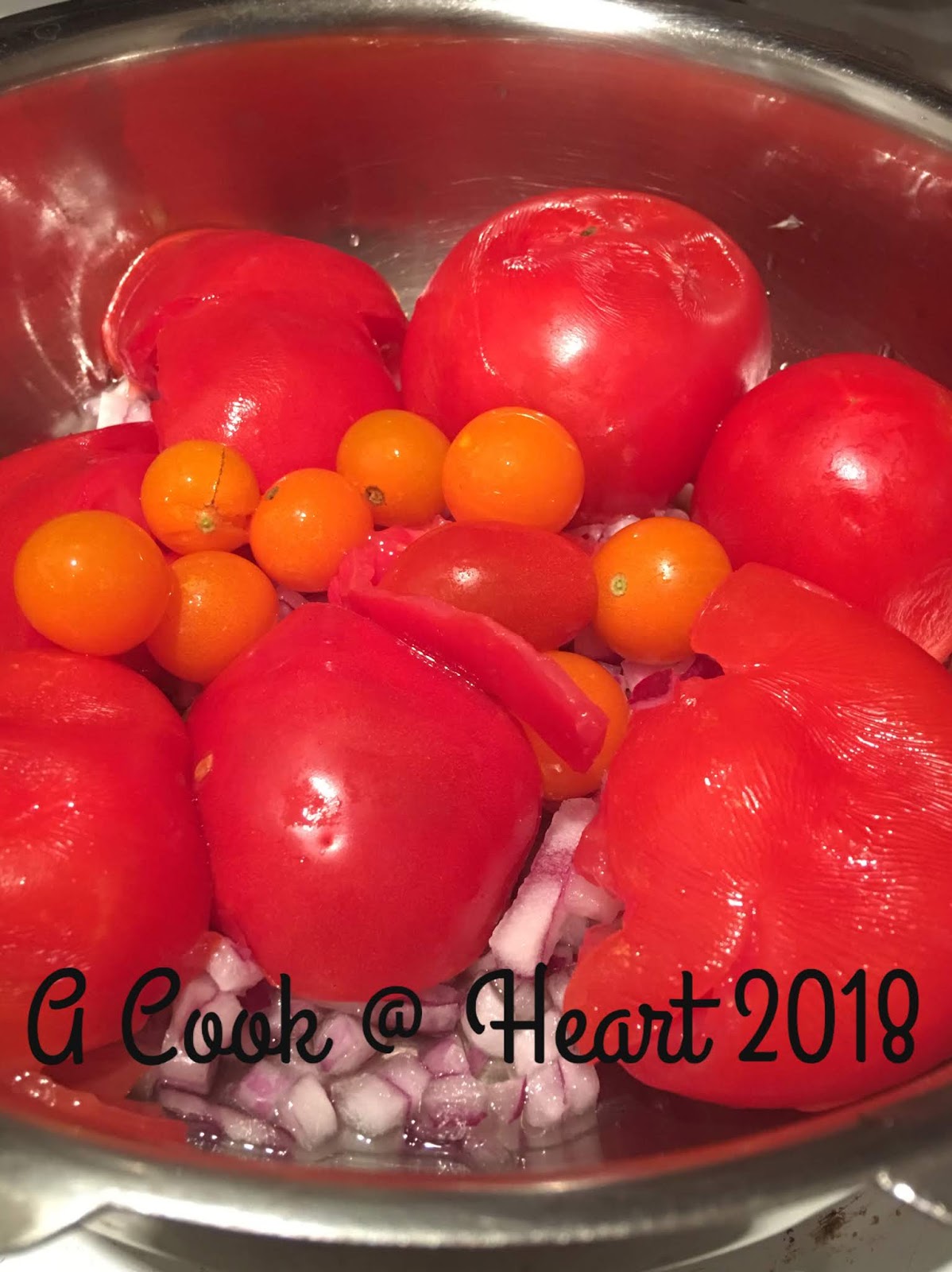
In the Pressure cooker, Layer as follows:

Add the water at the base.

Top with Butter

Add the Garlic clove

Add the onions 

Layer tomatoes on top.
I had these tiny tomatoes, so I just lobbed them in.

Seal the pressure cooker with the weight / whistle and cook on high for 5 minutes. 

Switch off the heat and release pressure, carefully. Use a spatula to lift the weight slightly to let the steam escape.


At this stage, if you want, carefully lift and discard the tomato skin ( I always do).

Add salt and pepper powder to taste. Add a spoonful of sugar to balance the flavors. I did not add as the little orange tomatoes were sweet and they balanced it out.

Blend the tomatoes. I used my immersion blender. 

Add water/ stock if needed to dilute the soup to suit how thick you want it. 
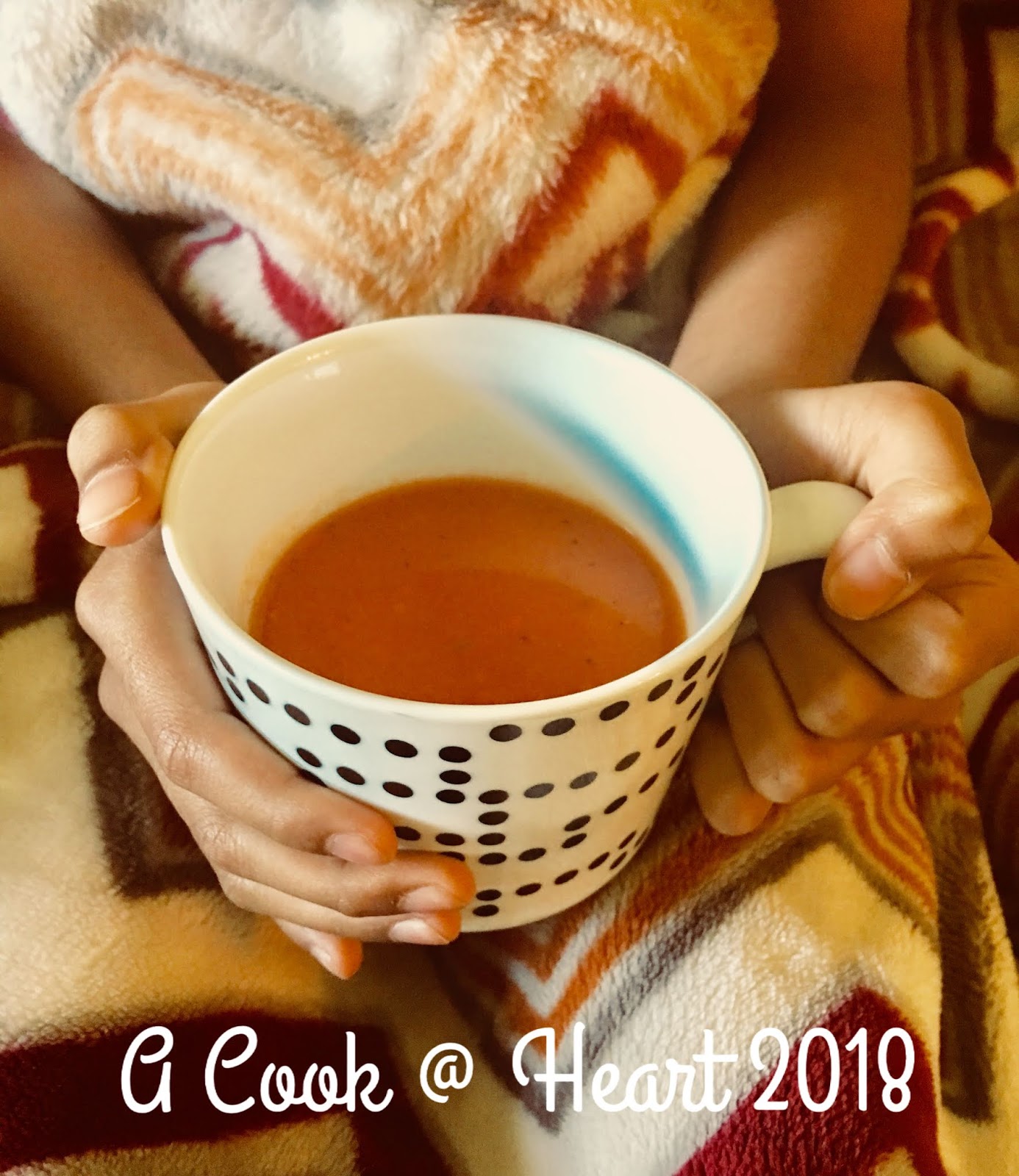
There you have it! All done. 
Add croutons, a splash of cream if desired. 
Serve hot. 
Check out the other OPOSed recipes here.

Wish all those celebrating, a VERY HAPPY AND MERRY CHRISTMAS! 

HAPPY NEW YEAR WISHES, IN ADVANCE! 


Pin It

Tuesday, June 26, 2018

OPOS Pineapple Sheera / Kesari

The best tasting sheera is, when it is made for a puja. But it was always one made with bananas. I always thought there was one way of making sheera, that was either plain or as a variation (and strictly on puja )with bananas. The thought that any other fruit can be used was alien. 
Imagine my surprise and delight when I tried a spoonful of Pineapple sheera! It was a flavor bomb and I was left craving more.

When M came to see me ( the arranged marriage scenario) we served him Pineapple Sheera, to date I wonder if that clinched the deal.


Here I have made this sheera /kesari using OPOS (One Pot One Shot) method, developed by Chef Rama Krishna, which cut down on time and extra steps. 
OPOS method uses layering method and cooking on high heat for a short time. This ensures that food is cooked properly, retains nutrients and also color (for vegetables like ivy gourd, spinach beans).


Here is my recipe, inspired by OPOS technique.

1/2 cup, Double roasted Rava*
3/4 Cup Sugar (1 cup, if you like it sweet)
1 cup Pineapple chunks
3 Tbsp Ghee 
2-3 Cloves
a few Raisins (optional)
Saffron strands (optional) 
1/8 tsp Pineapple Essence
2-3 drops Yellow food color (optional)
Pinch salt
2 Cardamom pods, powdered
1 cup Water


* If you are in India, you can easily get double roasted rava in any grocery store. If you cannot get your hands on any, roast rava over medium flame, cool and roast it again. This can be stored and used as needed.


To start off, (since I do not get double roasted rava), heat 1 tsp ghee and add cloves to it, once the ghee is perfumed, add the rava and roast it till it is aromatic and a few shades dark.


In a 2L pressure cooker, add 1 cup water, sugar, pineapple chunks, ghee, cardamom powder, saffron (if using)


Cook on high heat for 1 whistle (ensure that the heat does not come up the sides of the cooker it covers the bottom/ base only). Switch off the heat and in a couple of minutes, manually release the pressure. Be VERY careful, do not apply force. Use a spatula or tongs to lift up the whistle and let the steam escape. 
Open the pressure cooker and slowly add the roasted rava, stirring continuously to avoid lumps. 
Seal the cooker and let the mixture cook in the retained heat. Do not switch on the stove. 

Wait for 10 mins. to let the rava cook and absorb all the liquid.
Open and stir gently to ensure it is all mixed well.
Serve warm.

Notes:

-You can use Bananas instead of Pineapple (or fruit of your choice, ex banana, mango)

-Cloves pair well with pineapple sheera, if using another fruit, avoid these, cardamom should do the job.

- As always, make sure you standardize your equipment, if you haven't, here's how.


Pin It

Wednesday, April 11, 2018

Ghadichi Poli and Methi Zunka, OPOS (One Pot One Shot) style.

Every Marathi household, it seems is obsessed with 'ghadichi poli'.
My mother always made 'ghadichi poli', until one day she came home, full of enthusiasm. Her Gujarati friend ( could be a friend from the office canteen or the train or, bus stop, I have no recollection, she has friends everywhere) 'taught' her the art of making fulka. After that we had fulkas for a long time.
But, she went back to making what she grew up eating, you guessed it, 'ghadichi poli'.
My grandmother also, always made the same.
I never paid any attention.
Life went on..
Then one day, I was at a friends place, she was going to get married and we had gone shopping. We returned home and after a bit of rest, she went int o the kitchen and started cooking for her father and brothers. V, deftly rolled out a circle of dough, spread a thin layer of oil and folded it into a semi circle  and then into a triangle.
This she dredged into flour and proceeded to roll the triangle into a perfect circle.

I was *very* impressed!
I was at the amoeba stage of rolling out flatbread.

Years later, after I was married and living in California, I was a part of a small group of ladies who met in the park and organized potlucks and festive get together.

 So we had this orkut  (anyone remember that now?) message circulating listing what each one of us would bring to the potluck.
When I did the final list and sent it to all concerned, pat came a reply..

Pallavi, me Ghadicha polya anat ahe. Tu faqta poli lihilays majha nava pudhe, mhanun mhatla tula sangava. (Pallavi, I am making tri-fold type chapati (poli), you have mentioned only chapati, so I thought I'd better let you know)


To this day, I have no idea what difference it made, but I never asked or argued.

But I still find it funny. Maybe it is a big deal.

To come back to this post and to introduce to you ( if you aren't familiar with it already) the OPOS system. This One Pot One Shot method is currently revolutionizing cooking.

I found a video on youtube and just clicked on it to view what it could be and found this extremely convenient method of cooking.
I am attaching links below so you all can also benefit from it.

I have tried a few recipes and have had success with all of them. Now that I am confident, I  feel it is time to share it. Tried and tested and all that.
 OPOS uses a regular pressure cooker, a 2 liter one to quickly cook food, while preserving nutrients and skipping the long step by step process. This technique is clearly and lucidly explained by Chef Rama Krishnan in the videos. 

The first thing is to standardize the equipment (a simple process) and then get cooking. click here to  follow the steps to test and standardize your cooker. LESSON 1 

The gist of OPOS style of cooking is, layer food in a certain manner and cook it on high heat, thus yielding in completely cooked, tasty food in minutes!

The other recipe I tried and was happy with is Attalysis (autolysis, is the correct term). This is an easy method of 'kneading' whole wheat flour into a soft dough for making flatbread.

The idea is to add water to flour ( follow the video to understand how) and let it absorb, undisturbed.
The flour absorbs the water and makes kneading almost effortless! The resulting dough is also very soft and also stores well in the fridge for 3 days ( that's the most I've stored it).

So how is this better or different from using the traditional method of dough making or even using the food processor or the heavy duty stand mixer?
Very different!
When using the traditional method, we add water slowly to the flour and knead the dough to the consistency we require ( roti / poori). Most women eyeball the quantity of water and go by the 'feel'.
Similarly, we, I also add water to the flour when kneading using my stand mixer. And I admit, sometimes the dough is softer than I'd like.
And with the stand mixer, I knead more dough, because of the bowl capacity. Too little flour and you cannot mix it...

But this problem is eliminated when using  'attalysis'. plus, the biggest advantage, for me, is the almost no kneading. With my tendinitis and wrist pain, it is rather difficult for me to knead dough without feeling very uncomfortable. On days when I require a small amount of dough and don't want to use the stand mixer, this is the best and the easiest method.
To make 'ghadichi poli' :

Knead the dough using Attalysis method inspired by OPOS. Method developed by Chef Rama Krishnan.
The proportion that worked for me is:

2 1/4 Cups of  whole wheat flour
1/2 tsp Salt
1 cup water

Mix the flour and salt.
Add the dry ingredients t the water and using a fork or a spoon, mix the water and dough to a shaggy mix. Don't over mix or knead. Just mix it and cover and let it rest for 30 mins.
After 30 mins., lightly oil you hand and knead the dough. You will notice  that the water has been completely absorbed and the shaggy dough is very easy to handle and comes together in a very short time to form a soft dough.
At this stage ( ready ball of dough) I cover and keep aside for 10 mins.
If you need the dough for later, just place it in an airtight container and place it in the fridge till you need it.

If you are ready to make roti /poli, set your tava on the gas and let it heat up. Now, take a small portion of the dough ( lemon sized). Roll it between the palms of your hand and make the ball smooth,


OPOS , one pot one shot
Roti Dough made using Attalysis

Dredge it in dry wheat flour and roll it applying even pressure. Roll it to approximately a poori size.


Using a pastry brush or a spoon, drizzle a bit of oil on the rolled disc and spread it around.


Fold it over and smear a bit of oil on the upper side.


Now, fold it in to a triangle, like so..


Dredge the triangle into some dry flour and start rolling. Apply even pressure and roll out the triangle into a round shape. And if it stays a triangle  (or decides to form a shape unknown), never mind, it will still taste good. Just roll it evenly. 


Once you have a thin flat bread, carefully lift the disc and place it on the hot tava. Be careful.


Keep the heat at medium-high and let the flat bread cook. You will notice that it puffs up beautifully! It will also cook well and have brown spots.


Flip it and cook it on the second side as well. If you feel that the first side is completely cooked, do not flip again. IF any portion needs a bit of browning, flip it once more and let it cook for a few seconds and then take it off the heat.


Apply ghee and serve or place in the container ( policha dabba) for later. 

Ghee is a Must!


Ready to serve and enjoy! 

NOTES:

-This method of making roti keeps the roti softer for a longer period of time
- The technique of folding and rolling out creates thin layers in the bread. 


I served the flatbread with Methi Zunka. A staple in most Marathi homes, this humble Zunka is very versatile and can be made with very few ingredients. It is 'everyday fare' for a farmer toiling in the fields and now, many fancy restaurants are serving it up, garnished and glamouring (you know what I mean) it up! 
I often make this as a 'subji' to go with my flatbread. 
This time I tried OPOSing it and boy! I was pleasantly surprised!

The OPOS Zunka is simple and time saving.

I made some small changes. 

I used 

1 cup Besan (chickpea flour) to which I added a bunch of spices, 1/2 tsp EACH of roasted Cumin and Coriander powder, 1/2 heaped tsp of Garam Masala, Salt and some sugar,  1/2 tsp of Turmeric, 1/2 tsp of  Red chili powder 

Chop 1 medium onion and divide it. 

To this dry mix I added half the finely chopped Onion and one bunch Methi (fenugreek) leaves and  mixed it to form a dry mix, Do not add any water, the salt in the dry mix will make the onions and methi release moisture and make the mix slightly damp.                           

To the 2 L pressure cooker, add 3 Tbsp water. 

Add 3-4 Tbsp oil ( I know this sounds a lot, but this is what worked for me. If you are not happy about using all that oil, cut it to 2 tbsp, as the chef recommends.)

Add the remaining onions. This is the buffer layer.

Now add the besan mixture. Do not pack it in, just layer it lightly on top of the onions. If you press it down, that will cause burning. You don't want that. 

Cook this over high heat for 1 whistle only. This should happen around the 3 min 30 seconds mark.

Switch off the heat and release pressure manually. 

Stir the ingredients.

Transfer to a serving bowl and garnish with chopped cilantro ( this is optional). 

Serve with Bhakri or Poli.

*watch the video linked above to also see how not to make this zunka in a cooker. 

- If you use 2 tbsp oil, there will be some charring at the bottom.
Since I doubled the oil proportion there was absolutely no charring and the zunka was moist and well cooked. 


#OPOS


NOTES:

- Please go through the lessons on OPOS method of cooking.
- Use the equipment as suggested.
- Keep track of the changes you make with notes, if you want to modify or understand how and where things changed if the recipe did not turn out the way you wanted,

Pin It
Share

LinkWithin

Related Posts Plugin for WordPress, Blogger...
Page copy protected against web site content infringement by Copyscape